Research Poster Template
Academic research poster templates for conferences, symposia and poster sessions in any discipline. Choose a landscape or portrait layout, three or four columns, or a central-finding design, and fill in the sections with your own text, figures and references.
Research Poster Template Pack
Five editable conference poster layouts plus a section writing guide and printing checklist.
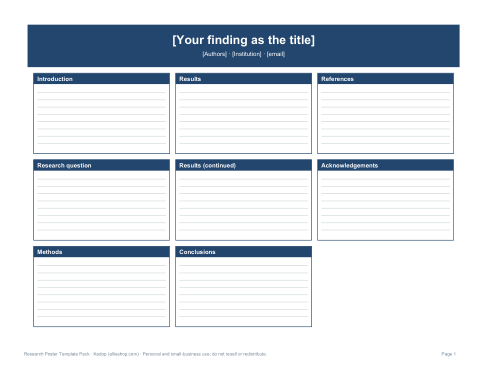
- Landscape 3-column poster (PDF, DOCX)
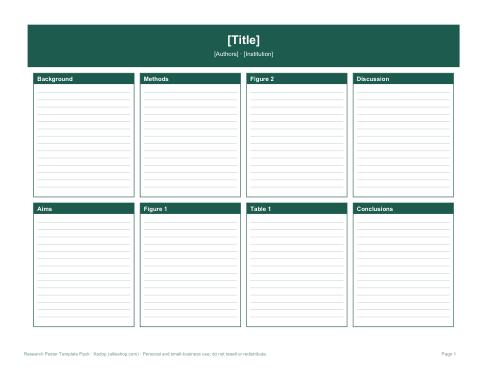
- Landscape 4-column poster (PDF, DOCX)
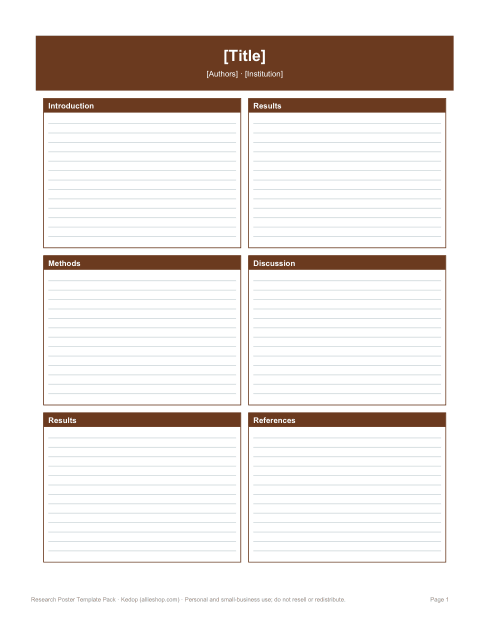
- Portrait poster (PDF, DOCX)
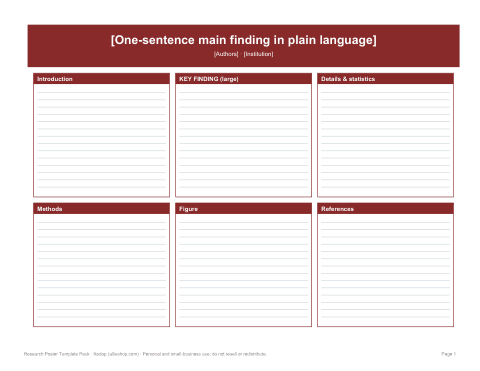
- Central-finding layout (PDF, DOCX)
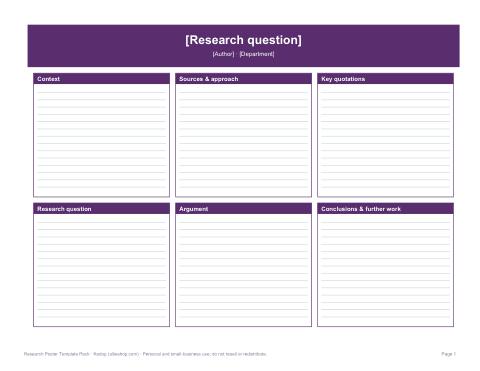
- Humanities / social science layout (PDF, DOCX)
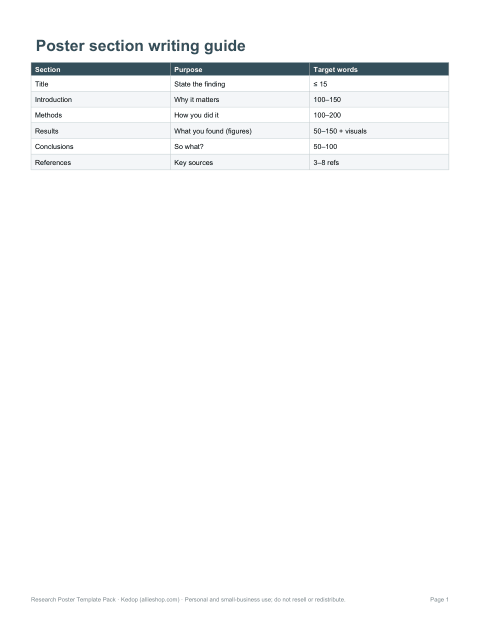
- Section writing guide (PDF, DOCX)
- Printing & session checklist (PDF, DOCX)
Formats: PDF, DOCX. Instant download after payment (link valid 72 hours, up to 5 downloads). AI-assisted: the templates were drafted with AI help and reviewed and laid out by Kedop.
$9.00 USD, one-time
Secure card checkout by Stripe. Full refund within 7 days — see the refund policy and license.
What is included
- Landscape three-column poster — the classic layout for 48 × 36 inch boards.
- Landscape four-column poster — for results-heavy posters with several figures.
- Portrait poster — for 36 × 48 inch portrait boards common at some conferences.
- Central-finding layout — a large central statement of the main result with supporting columns either side.
- Humanities / social science layout — more room for text, quotations and a research question panel.
- Section writing guide — what to put in each section and how many words.
- Poster session checklist and printing guide — sizes, file export and what to bring.
How to structure a research poster
| Section | What to include | Typical length |
|---|---|---|
| Title | The finding or question, not just the topic | One line, readable from 5 m |
| Authors & affiliations | Names, institutions, contact email | One line |
| Introduction / background | Why the question matters, gap in knowledge | 100–150 words |
| Research question or aims | One or two sentences | 1–2 lines |
| Methods | Design, participants/materials, analysis | 100–200 words or a diagram |
| Results | Key figures and tables with short captions | Mostly visuals |
| Conclusions | What the results mean, limitations | 3–5 bullet points |
| References & acknowledgements | Key citations, funding | Small text |
A good rule is that the whole poster should contain no more than about 500–800 words. Visitors typically spend only a few minutes at each poster, so the title and main figure have to carry the message.
Common poster sizes
| Size | Orientation | Notes |
|---|---|---|
| 48 × 36 in (122 × 91 cm) | Landscape | Most common in North America |
| 36 × 48 in | Portrait | Used when boards are tall |
| A0 (841 × 1189 mm) | Portrait | Common in Europe and Asia |
| 42 × 56 in | Landscape | Larger boards |
Always check the conference's instructions for maximum dimensions and orientation before designing. The Word templates are built at a smaller page size with the correct proportions, so you can scale the exported PDF up to the final print size without distortion.
Design tips
- Make the title readable from about 5 metres (roughly 85–100 pt or larger at full size).
- Use body text of at least about 24 pt at full size so it can be read from a couple of metres.
- Arrange content in columns that read top to bottom, left to right.
- Use high-resolution figures (300 dpi at the final size) and label axes clearly.
- Keep a consistent colour scheme, ideally your institution's, with strong contrast.
- Leave white space; crowded posters are skipped.
Printing and presenting
Export the final poster to PDF and check it at 100% zoom for blurry images. University print shops and online services print posters on paper or fabric; fabric posters fold into a suitcase. At the session, prepare a one-minute summary and a three-minute walk-through, bring pins or Velcro if not provided, and consider printing A4 handouts or a QR code linking to your paper or data.
Formats
All layouts are editable DOCX files with matching PDF previews. Section boxes are text boxes and tables you can resize. The writing guide and checklist are Word and PDF files. You can also recreate the layouts in PowerPoint or a design tool using the PDFs as a guide.
Adapting the poster for different disciplines
Laboratory and clinical research posters usually centre on figures, with methods condensed into a flow diagram. Social science posters often need a clear statement of the research question, a sampling summary and one or two key tables. Humanities posters may present an argument, key sources and short quotations, with images of primary materials. Engineering and computing posters benefit from a system diagram and a results table comparing approaches. The layouts in the pack can be adapted for each: merge boxes for large figures, or add a narrow side column for quotations and references.
Frequently asked questions
What size is a research poster?
Commonly 48 × 36 inches landscape in North America or A0 portrait in Europe, but always follow the conference instructions.
Can I use these in PowerPoint?
The templates are Word and PDF files. Many people build posters in PowerPoint; use the layouts as a guide.
How much text should a poster have?
Usually no more than about 500–800 words, with figures carrying most of the message.
Will the poster print sharply at full size?
Text will, because it is vector. Insert images at high resolution so they stay sharp when scaled.
Were AI tools used?
The layouts and guides were drafted with AI assistance, then reviewed and formatted by Kedop.